What Waiters Know About Effortless Productivity That You Don’t
Why your daily tool-switching is costing you more than you think
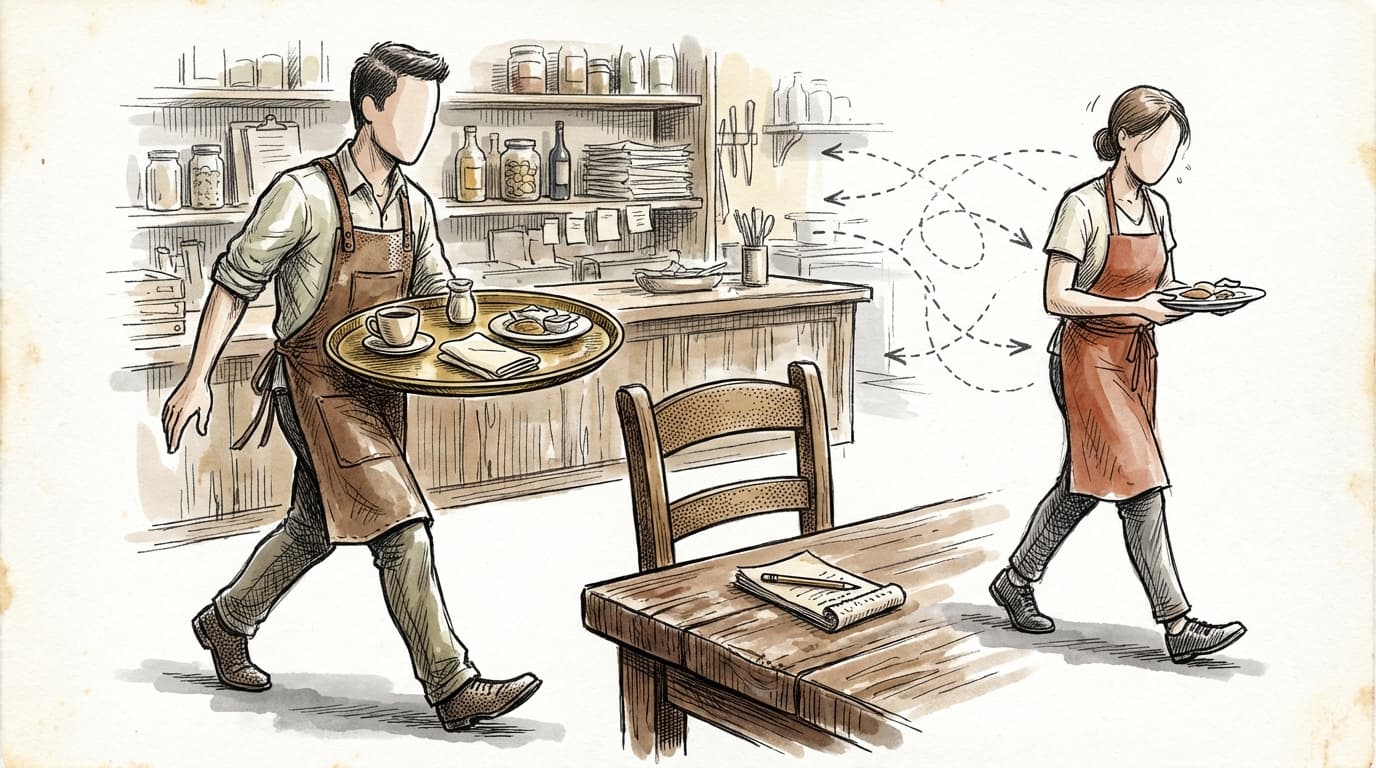
I was several weeks into my job at Pappasito’s when I finally figured out why I always found myself “in the weeds” when things got busy. It wasn’t that I was slow – it was that I was inefficient in a way I didn’t even notice.
I’d go to the kitchen to drop off dirty plates, then walk back to the dining area. Two minutes later, I’d realize I needed queso for table six and make another trip to the kitchen. Then I’d head to the bar to order margaritas for table twenty-one, completely forgetting that table twenty-two needed two glasses of water – which I could have grabbed while I was right there.
Meanwhile, the experienced servers seemed to glide through their shifts. They’d hit the kitchen, grab the queso, check on their orders, and pick up chips for another table – all in one fluid motion. At the bar, they’d order drinks, fill water glasses, and chat with the bartender about the Rockets game, somehow accomplishing three things in the time it took me to do one.
I was making the same number of trips to each space, but I was leaving value on the table every single time.
That experience taught me something I still use two decades later: before you optimize how you do something, optimize how many times you have to go there to do it.
The Real Cost of Space Visits
Here’s what I learned in that restaurant, and what most knowledge workers never realize: every space visit is expensive, whether that space is physical or digital.
In the restaurant, the cost was obvious – wasted steps, exhausted legs, annoyed customers. But in knowledge work, the cost is hidden. Every time you “quickly check” email, pop into Slack, or switch to another browser tab, you’re paying a switching tax that’s way higher than you think.
Research by Dr. Gloria Mark at UC Irvine shows that knowledge workers average only about 3 minutes on any single task before switching, and when work is interrupted, people typically don’t return to the original task immediately. What’s even more interesting – most of us interrupt ourselves constantly. We visit our email space 50+ times per day, check Slack every few minutes, and bounce between apps like digital nomads.
I tracked this for a week last year and was genuinely shocked. I was visiting Slack 73 times per day. Seventy-three. That’s once every 6-7 minutes during working hours. Each visit lasted maybe 30 seconds, but the context switching was killing my deep work capacity.
The AI Space Visit Problem
I see this same pattern with AI adoption, and it’s fascinating. People are making ChatGPT into another space they visit inefficiently.
Here’s what this looks like in practice – someone might ping ChatGPT eight separate times in a day to:
- Write one email
- Analyze one document
- Brainstorm three ideas
- Edit two paragraphs
- Research one topic
- Create one outline
- Review one proposal
- Generate one summary
Eight separate visits for tasks that could have been consolidated into two focused sessions. Each visit required reloading context, re-explaining background, and rebuilding the conversation thread.
Meanwhile, the people getting incredible results from AI have figured out consolidation. They’ll gather five emails that need writing, three documents for analysis, and two concepts to explore, then have one substantial conversation that knocks out everything at once.
Same tool, same intelligence, completely different efficiency because they’re optimizing space visits instead of individual tasks.
Why Smart People Miss This
I think there are three reasons bright people fall into the space visit trap:
First, it feels productive to “stay on top of things.” Quick email checks and Slack pops feel like good habits because they keep us informed. But information without action is just anxiety fuel.
Second, we mistake motion for progress. Switching between apps creates a sense of activity that can mask a lack of real advancement on important work.
Third – and this one makes me laugh because I’m totally guilty of it – we treat our tools like slot machines. Each visit might be the one that delivers something important. Maybe there’s an urgent email. Maybe someone mentioned me in Slack. The intermittent reinforcement keeps us coming back.
But here’s the thing: urgent almost never means important. And the stuff that actually matters rarely comes through these channels anyway.
How You Can Start Consolidating
Want to try this? Here’s the approach that works:
- Step 1: Track your space visits for two days. Don’t try to change anything yet. Just observe. How many times do you visit email, Slack, your project management tool, even your browser bookmarks? I guarantee it’s higher than you think.
- Step 2: Identify your most expensive spaces. Which tools or platforms are you visiting most frequently? Those are your consolidation opportunities.
- Step 3: Design visit schedules. Instead of visiting email constantly, visit it three times with specific purposes: morning triage, midday processing, end-of-day cleanup. Instead of checking Slack every time you get a notification, visit it twice for focused catching up.
- Step 4: Batch similar activities. When you do visit a space, maximize the trip. If you’re in your email, handle everything that needs handling. If you’re in your design tool, tackle all your design tasks.
Tools can help with this too. I use Motion, which automatically batches similar tasks and optimizes my daily schedule. Instead of constantly visiting my calendar to reschedule things or decide what to work on next, Motion handles that planning work for me. The key is choosing tools that reduce your space visits rather than creating new ones to manage.
The transformation can be remarkable. When people cut their daily tool-switching from hundreds of instances to dozens, deep work time can dramatically increase. It’s not about working longer hours – it’s about bleeding way less attention to space visits.
It’s About Energy, Not Time
Here’s the key thing to understand about consolidation: the big benefit isn’t time savings, though that’s substantial. It’s energy preservation.
Every space visit burns cognitive energy on orientation: Where am I? What was I doing here? What needs attention? By the end of a high-switching day, you’re exhausted not from the work, but from constantly reorienting yourself.
When you consolidate, you preserve that energy for valuable thinking. You show up to each space with clear purpose and leave with clear completion. There’s something deeply satisfying about this that goes beyond pure efficiency.
It’s exactly what those great servers knew: smooth service isn’t about rushing around looking busy. It’s about moving with intention, accomplishing everything in the fewest trips, and having energy left for the customers who actually need attention.
The question isn’t “How can I do this faster?” It’s “How can I visit fewer spaces to get the same things done?”
Once you start asking that question, you’ll be amazed how much of your day was being consumed by expensive space visits you never even noticed.
Kenzie Notes
Analog wisdom for a digital world
A weekly page from The Workshop — frameworks, stories, and practical thinking on leadership, systems, and the craft of building things that matter. Wednesdays.